
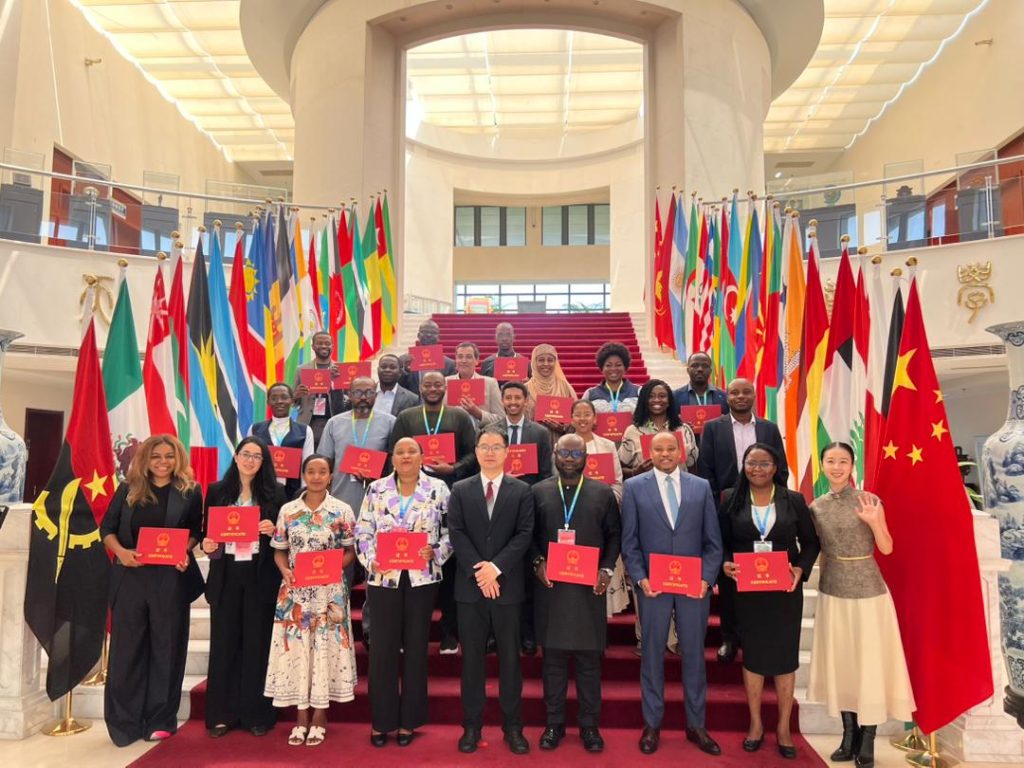
A three-member delegation from the State Interests and Governance Authority (SIGA) has completed a 15-day study programme in China focused on state-owned enterprise (SOE) reform and governance, with insights from the programme expected to inform Ghana’s ongoing reform agenda for its Specified Entities.
The delegation took part in the Seminar on State-Owned Enterprise Reform and Governance for African Countries, held in Beijing and Dalian from 10 to 24 June 2026. The programme was sponsored by China’s Ministry of Commerce (MOFCOM) and delivered by the Academy for International Business Officials (AIBO), as part of China’s broader programme of exchange with developing countries on public sector reform.
The delegation was led by SIGA’s General Manager, Operations, Ms Millicent Atuguba, and comprised Mr Joseph Sarpong, Head of the Governance, Risk and Compliance (GRC) Division, and Mr Eric Bonsu Agyabeng, Head of the Performance Monitoring and Evaluation (PME) Division.
A Comprehensive Programme Across Three Cities
The seminar was structured in three phases. The first, held in Beijing from 10 to 15 June, comprised academic lectures and field visits. The second phase, from 16 to 19 June, moved to Dalian for on-site enterprise teaching. The programme concluded back in Beijing from 20 to 24 June with workshop sessions and closing lectures.
In all, participants engaged with eighteen substantive topics delivered through twelve academic lectures, three on-site enterprise visits, five field trips and a dedicated workshop. Sessions were led by senior officials of China’s State-owned Assets Supervision and Administration Commission (SASAC), executives from major Chinese SOEs, and academic specialists in the field.
The curriculum traced the full arc of China’s four-decade SOE reform journey, covering legal and regulatory frameworks, financial supervision and debt-risk management, performance evaluation systems, investment management, large-scale innovation, and ESG and low-carbon management. Delegates also visited PowerChina and CRRC Dalian as corporate case studies, and took part in two dedicated sessions examining the China–Africa economic and trade relationship.
Key Lessons for SIGA and Ghana
A consistent message ran through the seminar: SOE performance improves when ownership is separated from day-to-day operational interference, when the ownership authority itself is professionalised and adequately resourced, when entities are classified and evaluated according to their actual mandate rather than a single generic template, and when performance evaluation carries real consequences for remuneration and tenure.
Chinese officials were candid that their country’s experience is not intended as a template for direct replication elsewhere, given differences in political systems, capital-market depth and fiscal capacity across countries. Rather, it offers a set of design principles that can sit alongside frameworks SIGA already benchmarks against, including the OECD Guidelines on Corporate Governance of State-Owned Enterprises and World Bank SOE toolkits.
China–Africa Economic Ties in Focus
The seminar also placed China’s SOE governance experience within the wider context of the China–Africa economic partnership under the Forum on China-Africa Cooperation (FOCAC). Delegates were briefed on the scale of that relationship: US$348.05 billion in bilateral trade in 2025, 33 China-backed economic and trade cooperation zones across the African continent, and a further US$80.6 billion in newly signed infrastructure contracts.
Particular attention was given to the opportunities available to Ghana’s Specified Entities under the 2024 FOCAC Ten Partnership Initiatives, which run from 2024 to 2027 — a period that overlaps directly with Ghana’s own 2026/2027 Performance Contracting Cycle.
Next Steps
The insights gained are expected to strengthen SIGA’s ongoing work to professionalise the governance, performance monitoring and risk oversight of Ghana’s state-owned and specified entities, as the Authority continues to align its practices with international best standards while adapting lessons to Ghana’s own institutional and fiscal context.